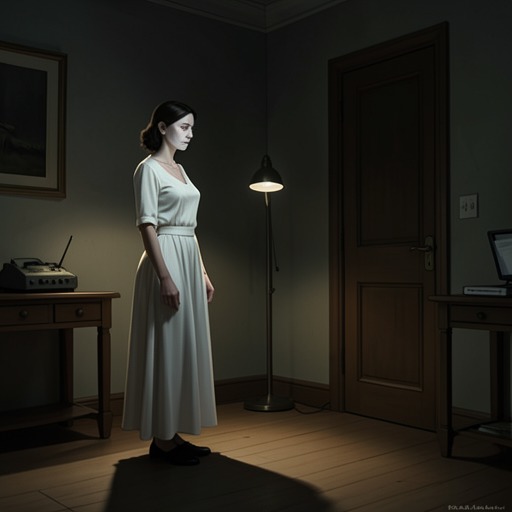
Nina is locked in the attic again and confirms her memories were real
The HousemaidIn Chapter 45, Nina Winchester returns to the attic expecting reassurance and instead discovers that Andrew Winchester has deliberately made her doubt a real history of captivity. Presented as Step Five in Nina’s account, the episode reverses Andrew’s promise to help her distinguish fear from reality: the room is exactly as she remembers, and his apparent tenderness has been the preparation for another imprisonment.
The promised test
Andrew brings Nina to the attic staircase and says that going upstairs will show her that there is nothing to fear and that the experience existed only in her head. Nina manages to agree, although the memory still feels real to her. She takes his hand as they climb the creaking stairs, thinking that a lightbulb in the area might make it less frightening. Even as she tries to accept his explanation, she recognizes that her own actions are no excuse for what she did.
At the top, Andrew presents the attic room as a storage closet that Nina has somehow transformed into a dungeon in her imagination. He checks whether she is all right before pulling the light cord. This careful approach sustains the appearance of a supportive husband: he accompanies her, gives her time, and frames the visit as an opportunity to overcome fear. But once the lights come on, their intensity overwhelms her. Nina releases his hand and covers her eyes; while she is blinded, the door slams shut.
Recognition in the light
As Nina’s eyes adjust enough for her to see, the room matches the place she remembers. The dingy cot stands in the corner; the closet contains the bucket; the mini-fridge is the one that held three tiny bottles of water. Those specific objects make the revelation concrete. The attic was not a fantasy assembled from fear: Nina recognizes its furnishings and the conditions she had experienced there.
When Nina asks Andrew to turn off the light, she reaches for the cord herself. The immediate relief of darkness lasts only until she realizes she cannot see at all. Andrew explains that he boarded up the window the previous week and installed new lights. With the window blocked, switching the bulbs off means pitch-black darkness; switching them on exposes Nina to their punishing brightness. The room offers no ordinary, comfortable level of light. Andrew has arranged its physical conditions so that even the choice of whether to see becomes part of his control.
Punishment and enforced secrecy
Andrew calls light a privilege and connects Nina’s confinement to wasting electricity, adding that his mother had noticed her failing to turn the lights off. The explanation turns a mundane household rule into the justification for severe punishment. Nina sinks to her knees as the language brings on déjà vu and nausea. Andrew then describes the arrangement as a choice between the harsh bulb and blackness, presenting a forced ordeal as though Nina were freely deciding how to endure it.
The argument also exposes how Andrew can use Nina’s public history against her. He invokes her hospitalization after she tried to kill herself and her daughter, claims the police witnessed the act and that Nina admitted to it, and contrasts those claims with the room’s appearance as an ordinary storage closet when the police came to investigate. Nina protests that the attic was real all along. Andrew says he wanted her to understand what she was dealing with and what would happen if she tried to escape. His admission confirms that the visit was not a therapeutic test: it was a demonstration of the threat he could impose while counting on others to disbelieve her.
When Andrew later says he is going to let Nina out, she expects him to delay again. Instead, he sets rules for her release. She must tell no one what happened in the room—not her friends, not her doctor, and not anyone else. He warns that speaking about it could be treated as evidence that her delusions have returned, with Cecelia Winchester’s safety raised as further leverage. The threat makes Nina’s history of psychiatric treatment more than an accusation: Andrew uses it to pre-emptively discredit her and to make disclosure seem dangerous to her daughter.
The attic as a continuing threat
Andrew’s final explanation is that he is watching Nina all the time and that this will be their life from then on: they will appear to be a happily married couple, and he will ensure that Nina performs the role of the neighborhood’s best wife. The ordinary public image he describes stands in direct contrast to the locked room and the coercion behind its door. Nina’s headache and her attempt to press her fingers into her eyes close the scene with the physical cost of the ordeal, while Andrew’s demand for acknowledgment leaves the threat unresolved.
The episode’s decisive turn is not merely that Nina is confined again, but that the confinement proves her memory trustworthy while showing how thoroughly Andrew has made truth difficult to establish. The cot, bucket, water bottles, boarded window, and altered lights supply material confirmation; his account of the police and her hospitalization supplies the counter-story he can use against her. By calling punishment a choice and secrecy a condition of release, Andrew makes the attic both a prison and a mechanism for maintaining the appearance that Nina is not being imprisoned at all.